Evolving Power Architecture for AI Data Centers
The “GPU + Battery” architecture has gained widespread adoption, driven by fundamental physical limitations of conventional power grids under modern‑era AI workloads. As high‑density AI clusters push per‑rack power consumption to 100 kW and even beyond 140 kW, compute scaling bottlenecks are no longer confined to chip‑level performance. Instead, the key challenge lies in handling severe instantaneous power transients.
During large‑model training and inference, tens of thousands of parallel‑running GPUs generate highly synchronized transient loads, creating multi‑kilowatt power surges within sub‑milliseconds. Traditional municipal power grids, transformers and centralized large‑scale UPS systems feature slow response and cannot withstand such high load change rates (di/dt). This easily triggers voltage sags and data‑center outages, forcing operators to over‑provision costly power capacity.
To address this pain point, leading cloud providers and AI compute facilities deploy Battery Backup Units (BBUs) directly within compute racks, tightly integrated with power shelves and GPUs. High‑rate lithium‑ion batteries are connected straight to 48 V or 54 V DC busbars, eliminating cumbersome multi‑stage AC‑DC conversions. When GPU workload spikes draw sharp current rises, rack‑mounted batteries discharge to the busbar within milliseconds. Power peaks are smoothed before disturbances propagate to the grid and upstream transformers, stabilizing overall facility power consumption.
This architectural shift fundamentally redefines battery roles in data centers: from passive emergency‑backup assets to always‑on dynamic load regulators. Rack‑integrated batteries no longer remain idle awaiting rare power‑failure events. Instead, they undergo frequent micro‑cycles during regular compute operations, absorbing transients and performing real‑time dynamic peak shaving.
Deep integration of GPUs and high‑rate batteries into unified “super‑nodes” enables data centers to deploy higher‑density compute hardware under constrained transformer power quotas. This significantly cuts peak‑demand power charges, mitigates voltage fluctuations, and protects mission‑critical compute clusters.

IBIH Thermal-Safety Solutions for Power Sidecars
While the BBU‑integrated architecture delivers substantial operational benefits, densely packed lithium‑ion battery modules introduce critical thermal‑safety hazards. In response to this emerging industry requirement, IBIH has developed high‑performance thermal‑safety material solutions.
We offer optimized aerogel composite sheets tailored for 800 VDC power sidecar systems in AI data centers.
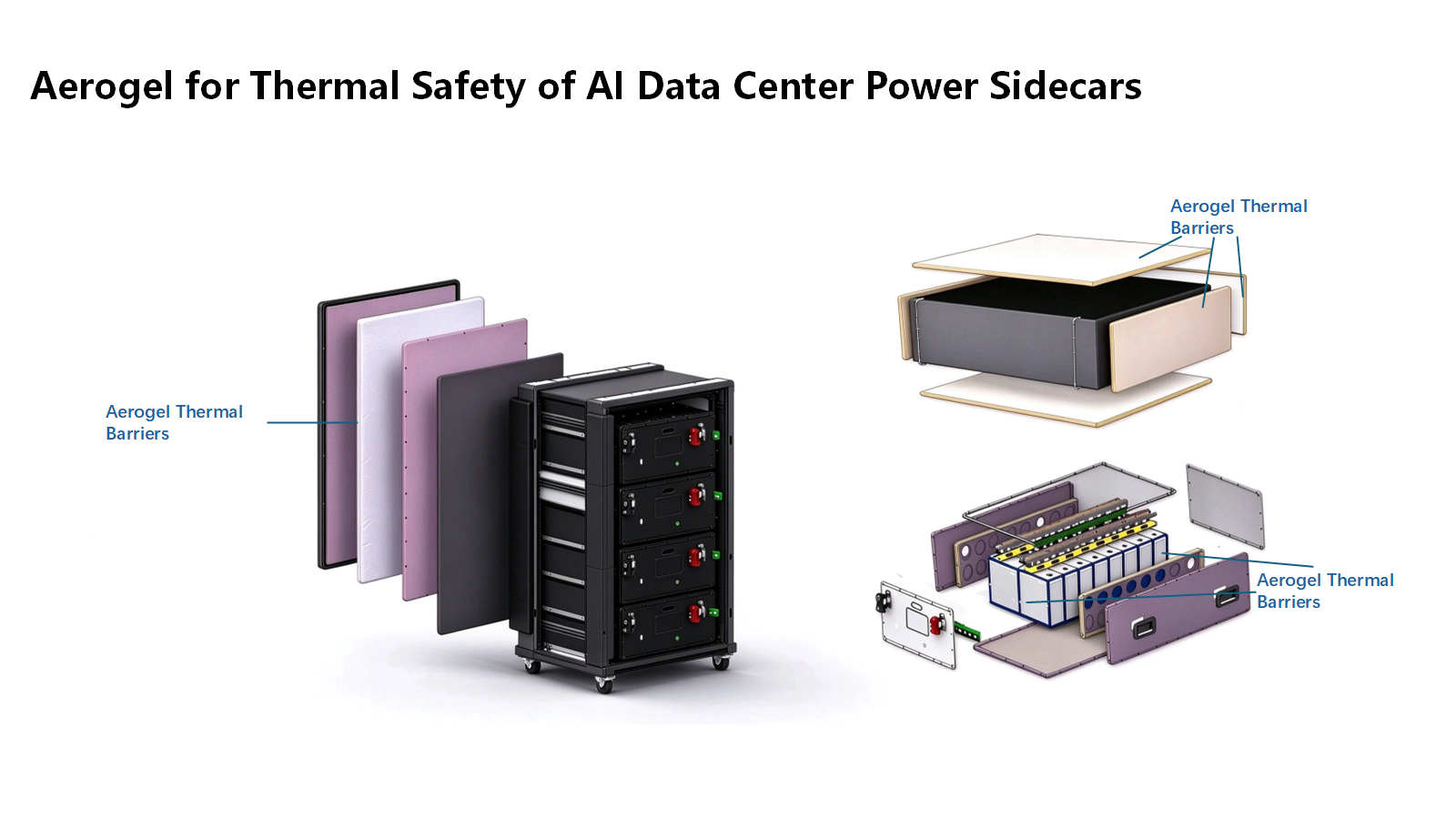
Our aerogel composite material delivers ultra‑low thermal conductivity, superior flame retardancy, reliable compressive stability and low dusting characteristics. It forms lightweight thermal barriers for BBU battery modules to suppress thermal‑runaway propagation. It also supports power‑electronics thermal isolation and cabinet fire compartmentation, with versatile deployment across multiple risk‑prone positions inside power cabinets:
1. BBU Battery Modules: Cell‑to‑cell and module‑level thermal barriers to contain thermal‑runaway propagation, compliant with UL 9540A.
2. Power‑Electronics Components & Solid‑State Circuit Breakers: Localized thermal insulation for high‑temperature components to reduce intra‑cabinet thermal crosstalk.
3. Cabinet Compartment Fire Segmentation: Fire‑partition materials slowing heat transfer between compartments, aligned with NFPA 855 design principles.
4. Supercapacitor Packs: Thermal containment for supercapacitor assemblies during abnormal thermal incidents.
Aerogel‑Composite Fire‑Suppression Patch
Beyond passive thermal‑barrier protection delivered by standard aerogel composite sheets, our aerogel‑composite fire‑suppression patches are thermally triggered at the onset of fire. They release perfluorohexanone gaseous agent to effectively extinguish incipient fires, bringing dual‑mode protection combining passive heat blocking and active fire suppression.
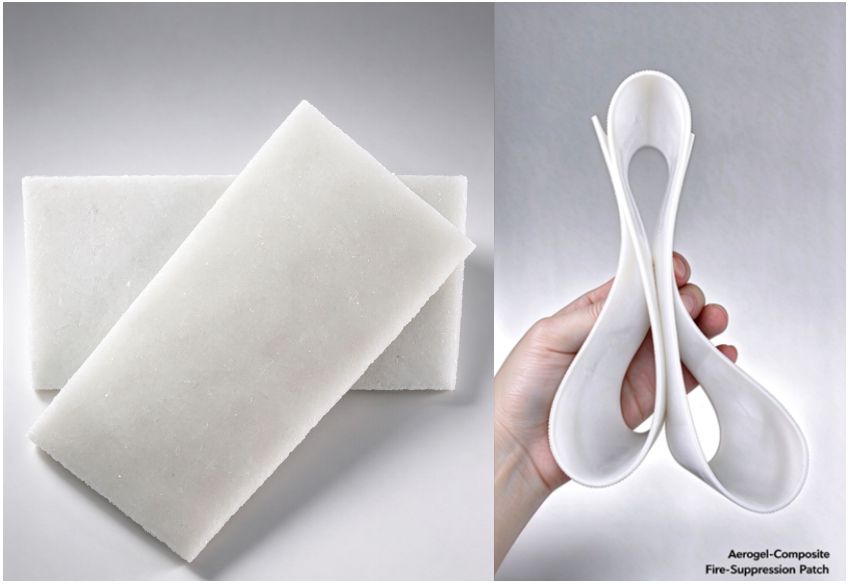
Custom dimensions are supported. Available customized thickness ranges from 1.5 mm to 4.0 mm. Joint thermal‑runaway validation and reliability testing services are available upon request.
Our proprietary ethanol‑based supercritical‑drying technology enables stable mass production of aerogel materials, delivering consistent product performance with competitive large‑scale manufacturing cost advantages.
IBIH keeps advancing aerogel‑based thermal‑safety solutions covering passive thermal barriers and active fire‑suppression materials for next‑generation 800 VDC power sidecar systems. Industry‑wide technical partnerships are welcome.
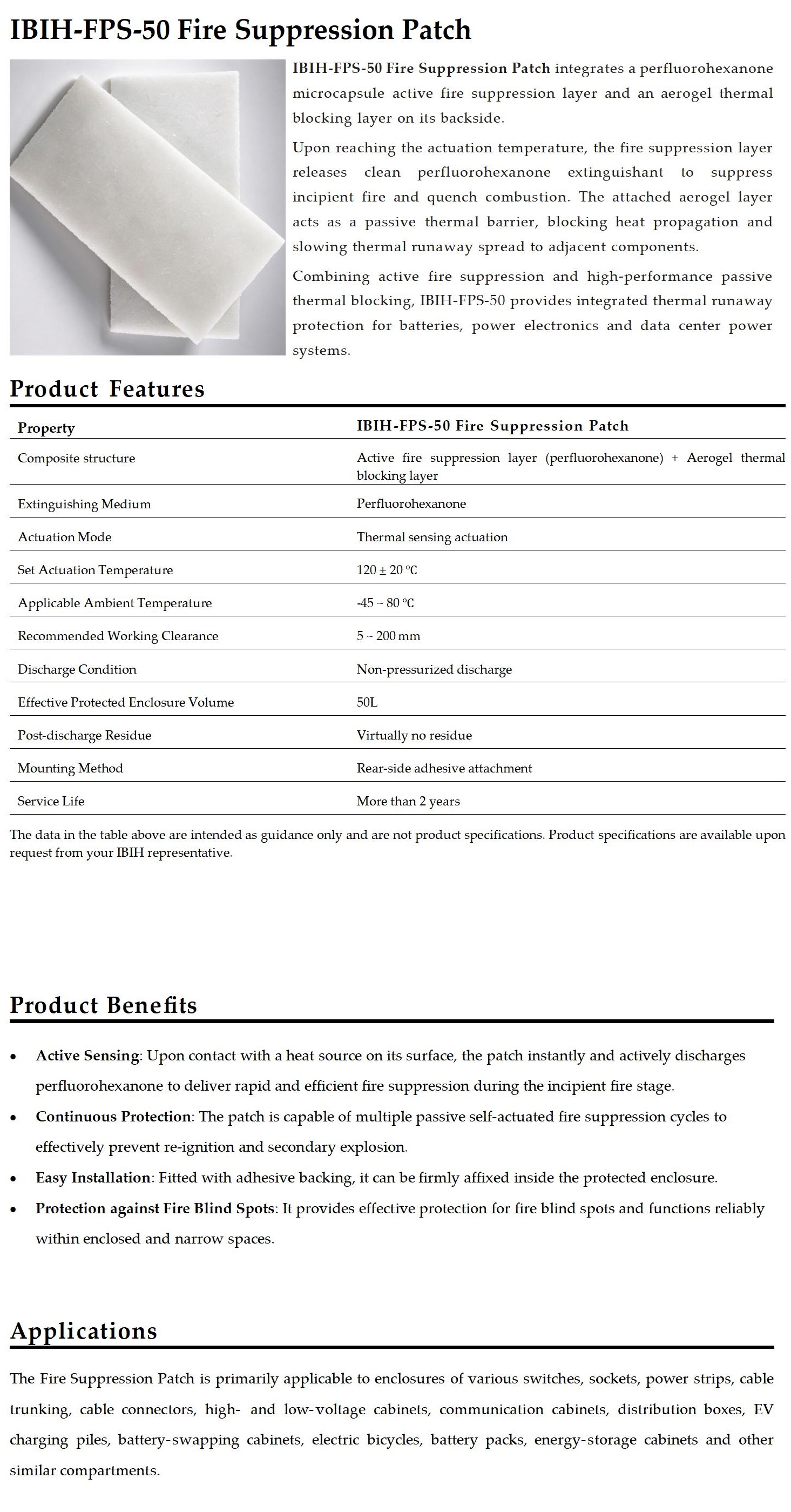
Appendix A: IBIH-FPS-50 Fire Suppression Patch Technical Data Sheet